Sunday, May 07, 2006

Misinformation in defense of net neutrality

Adam Green, responding to Mike McCurry, writes (following Matt Stoller at MyDD) that:

Lie #1: McCurry knows the Internet is not "absent regulation" yet he's willing to deceive the public if it helps his clients. As Matt Stoller points out on MyDD:

What McCurry did not tell the public was that during the Clinton years, the FCC actively enforced net neutrality -- the Internet's First Amendment -- against his telecom clients. Common carrier statutes have in fact been a bedrock principle of telecommunications law since 1934, and in 1996 Congress ratified that with a commitment to network neutrality.

Mike McCurry has a moral obligation to everyone who has ever respected him and looked up to him to answer this question: Do you stand by your statement that the Internet is "absent regulation?" Or do you admit that, like so many parts of our American economy, the Internet does have rules?

This is deceptive--ISPs are not common carriers and Internet services offered by telecoms are not bound by common carriage regulations. Internet services have been classified as information services or enhanced services, and thus don't have to collect fees for universal service or take anyone who comes along as customers. Common carrier means you have to accept everyone as a customer and not discriminate about what traffic that is carried (so long as it's legal), but ISPs can, do, and should set standards beyond what the law requires in order to (for example) keep spammers off their networks. Common carrier status has only an indirect relationship to the Internet and net neutrality--it is about physical interconnection, not about Internet interconnection.

Stoller goes on to describe the FCC regulatory change regarding DSL networks:

Yet less than a year ago, in August, 2005, the Clinton -Gingrich policy of enforced network neutrality was radically upended by the FCC:

The FCC said that phone companies such as Verizon, SBC, BellSouth, Qwest and other local telcos will no longer be regulated by traditional telephone rules when it comes to their DSL broadband services. The FCC agreed unanimously to classify DSL broadband as an "information service" rather than a telephone service. Phone companies will no longer be required open their broadband networks to access by third-party ISPs.

After a one-year transition period, the phone companies can arbitrarily end any agreements they were forced to make with independent ISPs. During the transition year, the ISPs can attempt to negotiate new deals, but the cards are all in the hands of the telcos.

In other words, you know all that nice Clinton-Gingrich policy that made the internet work? Yeah, after a one year transition period, that's gone, as a sort of sunset provision for the free internet sets. This is incredibly sneaky. What McCurry is doing is couching a radical change to the internet in the guise of the status quo.

Stoller makes it sound like this change has something to do with RBOCs' Internet services, but it doesn't. It has to do with other ISPs using RBOCs' last-mile networks to connect consumers to their own Internet services--those ISPs typically don't connect to the RBOCs' Internet services, but rather purchase IP transit from multiple backbone providers.

Contrary to Stoller and Green, there was no "Clinton-Gingrich policy of enforced network neutrality" that required any kind of interconnection between providers of Internet services--rather, there was a requirement that telcos provide the use of their last-mile networks to ISPs to use to carry their own Internet services.

That requirement seems to have been a good one for creating competition among Internet services, but it's important to be clear that we're talking about the last-mile telco networks and not their Internet services or their backbones, though the telcos have continued to try to present that as the issue and many net neutrality defenders have wrongly accepted that as the issue.

Last mile competition, unlike net neutrality, is a real issue, especially for consumer Internet access. It's less of a problem for businesses since there is wider competition available via colocation services, metro fiber networks, and wireless. In my opinion, the best long-term defense against a telco/cable duopoly will be wireless access solutions, though there will no doubt be some others like broadband over power lines.

It is distressing to see net neutrality advocates continue to get basic facts wrong in defense of their poorly thought-out positions. If you don't understand how the Internet works today (technologically, politically, and legally), then you are not in a position to be making proposals about how it should be regulated that are not going to have significant (and likely very bad) unintended consequences.


Saturday, May 06, 2006

Is There Really a Housing Bubble?

To many, the housing bubble seems a foregone conclusion. Uncountable blogs devoted to the bubble give the impression that you must be crazy or stupid to not see it. In spite of this, I remain unconvinced. I’m not even sure I know what the “housing bubble” is.

Here is a working definition:
…that housing prices have been pushed well beyond any semblance of reasonableness and the dictates of healthy market fundamentals due to excessive liquidity, extremely relaxed lending standards, a speculative mania, and the increasingly irresponsible "cheerleading" of vested interests.
Endless scary graphs,Click to enlarge like this one, which shows Phoenix appreciation rates over the past 30 years, seem to bear this out. Nonetheless, I am left with questions.

For example, who decides what price is “reasonable”? What standard should we use? Value is entirely subjective. Price, being a function of value plus ability to pay, can seem “unreasonable” to some, but “very reasonable” to others. The only one that matters, though, is the person who actually buys—and who, in so doing, reveals his opinion that the price is “reasonable.”

Where is the evidence of a “speculative mania”? You can’t simply point to the recent rapid appreciation rates and say, “See?”, because that’s assuming what you’re trying to prove. What evidence I’ve seen for this has been sparse and unconvincing, so far. Of course I could be wrong, and we could be on the precipice of the largest housing price decline in history. Unfortunately we’ll only know in retrospect.

The charge of “excessive liquidity” and “relaxed lending standards” also rings hollow to me. Now, it seems certain that the amount of borrowing taking place has increased significantly, but that could be caused by any number of things. Why does this automatically mean that lenders have become “extremely relaxed” with their money—which I presume means they’ve suddenly become willing to lend to any fiscally irresponsible idiot, as long as he has a heartbeat? This seems a testable hypothesis to me. If such an explanation were true, wouldn’t you expect to see foreclosure actions increase over time, as the bad debtors began defaulting on their loans?

When debtors default on their loans, lenders need to provide public notice of the impending sale of the property. These notices get recorded at the county recorders office, usually in the form of a Notice of Trustee’s Sale. In order for a lender to record a Notice of Trustee’s Sale, a borrower has to be at least 90 days late on her mortgage payments. Luckily, Maricopa County makes these records easy to obtain.

This graph shows data I’ve compiled Click to enlargefrom the Maricopa County Recorders office. The blue line is the number of Notices of Trustee’s Sales per month, over the past 11 years. The dotted red line is a 3-month moving average. What does this graph tell us? My first impression is that it’s easy to see evidence of the 2001 tech bubble, but, if anything, Maricopa County seems to have recovered from that, as the average number of notices has returned to 1996ish levels.

Admittedly this one graph is hardly a death-blow to the idea of the bubble, but I believe it’s important to take note of it, if for nothing else, then at least as a caution against our tendency to succumb to Chicken-Littleism and confirmation bias.

Friday, May 05, 2006

National Day of Prayer II


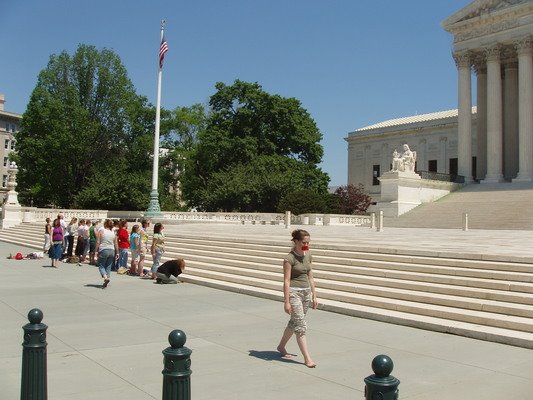
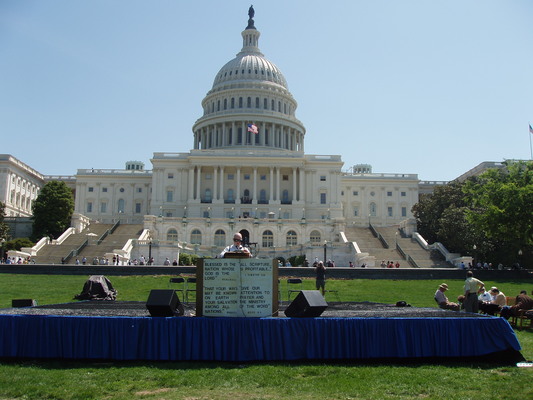
I went by the west lawn of the Capitol yesterday to see the set up for the National Day of Prayer event. There were a series of rotating speakers reading from the Bible to an audience of empty chairs (though I'm sure they filled them for their 5 p.m. event). We then had a scheduled private tour at the Supreme Court, and got to see the Justice House of Prayer/Bound4Life cult members praying in front of the steps--these are the "interns" who pay $500/mo or so (the fee details seem to have disappeared from their website, but it was $1500 for a 3-mo internship when I commented on them in December) for the privilege of praying the same 22-word prayer over and over in hopes that the Supreme Court will reverse Roe v. Wade. (I almost think such strategies should be encouraged. These interns aren't hurting anything with their "silent sieges," and it's keeping them out of other kinds of trouble they could be getting into or causing.)

We didn't make it back to the Capitol until later in the evening, instead choosing to eat an excellent meal in Chinatown with some friends.

(Previously.)

Facts about Mexico's drug decriminalization

The new law (which Fox has now declined to sign, and has asked for one that appears more anti-drug) would have the following effects:

1. Allow local police as well as federal police to pursue drug-related crime. This is a strengthening of anti-drug laws.
2. Codify the specifics for amounts of drugs which, if possessed, do not result in criminal prosecution, but diversion to treatment programs. Currently, this is at the judge's discretion, requires some kind of evidence of being an addict, and is apparently a source of corruption (pay a bribe, get the charges dropped). This change seems to be relatively neutral.

It doesn't appear to me likely that these changes would have much effect on the availability or acceptability of illegal drugs in Mexico.

Thursday, May 04, 2006

National Day of Prayer

Today is the National Day of Prayer, an event made permanent (on the first Thursday in May) by Congress and signed into law by Ronald Reagan in 1988, six years after the National Prayer Committee started pushing for it. Presidents had previously been able to declare National Days of Prayer whenever they saw fit, a tradition that became annual starting around 1951. Presidents can still augment this with additional National Days of Prayer, as Bush added a National Day of Prayer and Remembrance on September 14, 2001.

As I happen to be in Washington, D.C., very near the Capitol building, I'd like to check out the event on the west lawn of the Capitol tonight (unfortunately a previous dinner commitment overlaps with the event) and see whether the participants are able to reconcile their activities with the Bible, let alone empirical evidence for the ineffectiveness of prayer. In Matthew 6:5-7, Jesus condemns the false piety of "hypocrites" who pray in public, and advises that his followers pray secretly in their closets and not engage in "vain repetitions"--it's one of the most ignored verses in the Bible.

As the Freedom From Religion Foundation has pointed out for years, "nothing fails like prayer."

(Subsequently.)

Wednesday, May 03, 2006

Negative review of Colbert

Tuesday's Examiner (a free daily in Washington, D.C.) has a column by Karen Feld ("The Buzz," a gossip column) that reports on Stephen Colbert's presentation at the White House Correspondent's Dinner:
President Bush's clever presentation with Steve Bridges as his "id" was a tough act to follow for faux talk show host Stephen Colbert. Many, including the president, thought the comedian's jokes were too edgy and in bad taste.
I thought they were hilarious, deservedly harsh, and the dumbfounded silence of the audience was itself quite amusing. "It's funny, because it's true." It's too bad that it takes comedians to say what needs to be said right to the president's face.

Tuesday, May 02, 2006

Unitary Executive Doctrine

I've seen several people forward or cite Charlie Savage's Boston Globe article, which starts:
President Bush has quietly claimed the authority to disobey more than 750 laws enacted since he took office, asserting that he has the power to set aside any statute passed by Congress when it conflicts with his interpretation of the Constitution.
Among the laws Bush said he can ignore are military rules and regulations, affirmative-action provisions, requirements that Congress be told about immigration services problems, "whistle-blower" protections for nuclear regulatory officials, and safeguards against political interference in federally funded research.
Legal scholars say the scope and aggression of Bush's assertions that he can bypass laws represent a concerted effort to expand his power at the expense of Congress, upsetting the balance between the branches of government. The Constitution is clear in assigning to Congress the power to write the laws and to the president a duty "to take care that the laws be faithfully executed." Bush, however, has repeatedly declared that he does not need to "execute" a law he believes is unconstitutional.
Sheldon Richman points out the Savage article and also a Cato Institute publication titled "Power Surge: The Constitutional Record of George W. Bush" which says:
Unfortunately, far from defending the Constitution, President Bush has repeatedly sought to strip out the limits the document places on federal power. In its official legal briefs and public actions, the Bush administration has advanced a view of federal power that is astonishingly broad, a view that includes

* a federal government empowered to regulate core political speech -- and restrict it greatly when it counts the most: in the days before a federal election;
* a president who cannot be restrained, through validly enacted statutes, from pursuing any tactic he believes to be effective in the war on terror;
* a president who has the inherent constitutional authority to designate American citizens suspected of terrorist activity as "enemy combatants," strip them of any constitutional protection, and lock them up without charges for the duration of the war on terror -- in other words, perhaps forever; and
* a federal government with the power to supervise virtually every aspect of American life, from kindergarten, to marriage, to the grave.

President Bush's constitutional vision is, in short, sharply at odds with the text, history, and structure of our Constitution, which authorizes a government of limited powers.
Good readings for the week of "Loyalty Day."

Loyalty Day

This morning, while reading a thread about Stephen Colbert's wonderful performance at the White House Correspondent's Dinner, I learned that yesterday (and every May 1 going forward) has been officially proclaimed "Loyalty Day":

Loyalty Day is also a time for us to reflect on our responsibilities to our country as we work to show the world the meaning and promise of liberty. The right to vote is one of our most cherished rights and voting is one of our most fundamental duties. By making a commitment to be good citizens, flying the American flag, or taking the time to learn about our Nation's history, we show our gratitude for the blessings of freedom.

I spent most of my day yesterday at the U.S. Holocaust Memorial Museum. I'm happy to proclaim loyalty to principles of liberty, but that shouldn't be confused with blind loyalty to political leaders or governments.

Sunday, April 30, 2006

Breakthrough cephalopod design in power strips

The powersquid. (Seen in an advertisement in a recent in-flight magazine.)

Friday, April 28, 2006

Duke Cunningham bribery scandal may also become a lobbyist prostitution scandal

Tomorrow's Washington Post reports that:

Federal authorities are investigating allegations that a California defense contractor arranged for a Washington area limousine company to provide prostitutes to convicted former congressman Randy "Duke" Cunningham (R-Calif.) and possibly other lawmakers, sources familiar with the probe said yesterday.

In recent weeks, investigators have focused on possible dealings between Christopher D. Baker, president of Shirlington Limousine and Transportation Inc., and Brent R. Wilkes, a San Diego businessman who is under investigation for bribing Cunningham in return for millions of dollars in federal contracts, said one source, who requested anonymity because the investigation is ongoing.

[...]

The Cunningham investigation's latest twist came after Mitchell J. Wade, a defense contractor who has admitted bribing the former congressman, told prosecutors that Wilkes had an arrangement with Shirlington Limousine, which in turn had an arrangement with at least one escort service, one source said. Wade said limos would pick up Cunningham and a prostitute and bring them to suites Wilkes maintained at the Watergate Hotel and the Westin Grand in Washington, the source said.

There's more info and speculation at the Daily Kos.